
You’ve felt it.
That sudden, illuminating click. You read a book, you listen to a podcast, you have one profound session of therapy, and suddenly… everything makes sense. The fog parts. You see the patterns in your life, you understand why others behave the way they do, and you feel a wave of absolute certainty. You’ve found the answer.
You feel enlightened. Powerful. You might even feel a subtle urge to “fix” the people around you, to share this powerful wisdom they so clearly lack.
Now… pause.
Take a deep breath.
And allow yourself to consider a compelling question: What if that crystal-clear certainty… that profound “knowing”… is actually the most sophisticated trap your mind has ever set for you?
This is the seductive illusion at the heart of the Dunning-Kruger effect.
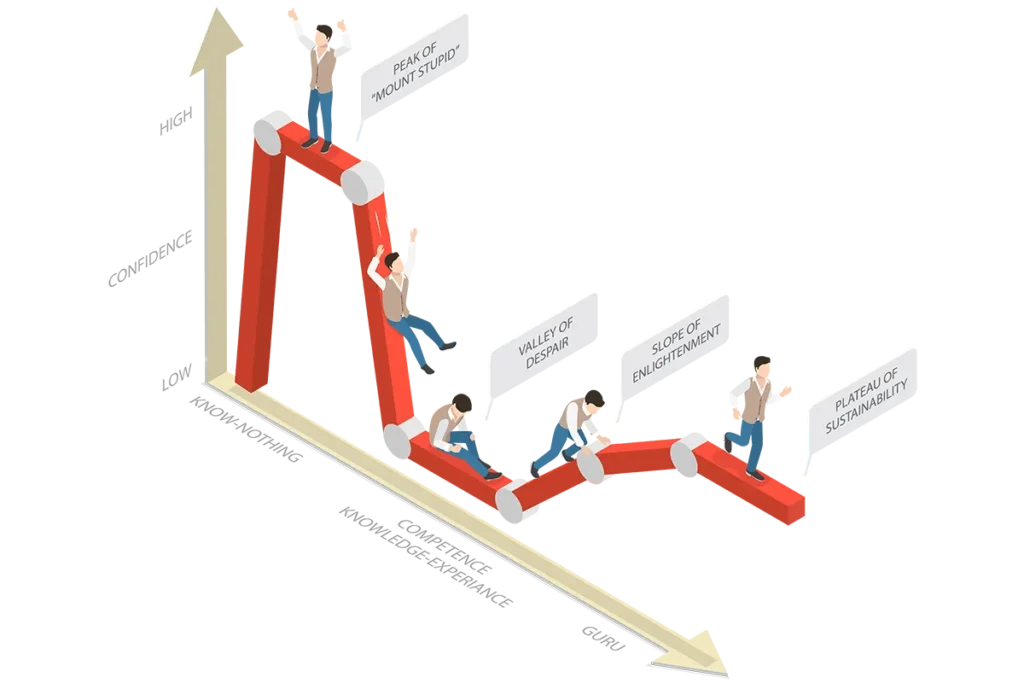
The Peak of Blinding Confidence
In the 1990s, psychologists David Dunning and Justin Kruger identified a fascinating cognitive bias. In short, they found that people with very little knowledge or skill in a particular area don’t just fail to recognize their own incompetence.
They do the opposite. They vastly overestimate their abilities.
This is the “Peak of Mount Stupid.” It’s the mental space where a little bit of knowledge feels like all the knowledge.
In the world of self-help and spirituality, this peak is a very crowded place.
It’s the person who, after one weekend workshop, believes they are qualified to psychoanalyze their friends. It’s the person who, after reading one book on manifestation, believes they have mastered the quantum mechanics of the universe.
This isn’t arrogance, not really. It’s a trick of the mind. The very skills required to judge competence are the same skills needed to be competent. Lacking the latter, you inevitably lack the former. Your mind, in its desire to protect you, fills that cognitive blind spot with a beautiful, blinding illusion of confidence.
The danger? You stop seeking. You stop growing. Why would you seek an answer you believe you already possess? You become locked in a room, celebrating your own genius, completely unaware that you are holding the key in your own hand.
The Valley of Humility (Where the Real Work Begins)
So, what happens when the person on the peak keeps learning?
This is where the true journey begins.
As you dive deeper—as you read the next book, as you encounter the true complexity of the human psyche (as Jung explored in the “shadow”), as you listen to masters who have dedicated their lives to this work—a different feeling begins to dawn.
The peak crumbles. You slide down into what many call the “Valley of Despair.”
This valley feels awful, but it is the most sacred ground in your entire transformation.
It’s the moment you realize the sheer, staggering vastness of what you do not know. It’s the realization that every answer only unlocks ten more profound questions. This is the moment of true humility. The ego, which was so proud and certain, dissolves.
Most people run from this feeling. They scramble back to the comfort of their first, simple answer.
But the true “soul-naut,” the true navigator of the self, stays. You sit in the valley. You embrace the “knowing nothing” state. Because it’s only from this place of emptiness that you can begin to be truly filled.
This is the death of the self-help “hacker” and the birth of the true seeker.

Escaping the Unconscious Trap
Here is the secret: The Dunning-Kruger effect is an unconscious bias.
You cannot “think” your way out of a thinking trap. You cannot use the conscious mind to identify a blind spot created bythe conscious mind.
Trying to “out-smart” the Dunning-Kruger effect is like trying to see your own eyeballs without a mirror. You must go deeper.
True self-discovery isn’t about accumulating more conscious knowledge, more life hacks, or more intellectual facts. That just builds a more sophisticated-looking peak.
True transformation—the kind we explore with tools like Rapid Transformational Therapy (RTT) and deep hypnotherapy—is about bypassing the conscious “knower” altogether. It’s about dropping into the vast, limitless library of the subconscious mind.
This is the part of you that holds the root of your patterns, the reason for your biases.
When you access this level, you are no longer trying to figure it out. You are allowing yourself to understand. You don’t just learn; you transform.
The funny thing? The other side of the Dunning-Kruger effect also exists. The truly competent, the masters, the people who have walked through the valley and are climbing the “Slope of Enlightenment,” almost always underestimate their own wisdom. They feel like imposters, because they are so acutely aware of the ocean of knowledge that still lies beyond them.
So, where are you on this journey?
Are you standing on the peak, certain that you have the map?
Or are you willing to step into the valley, close your eyes, and discover the compass that has been inside you all along?
The journey isn’t to the peak of a mountain. It’s to the center of your own mind. And from there, you can navigate anywhere.